

Cuna was born from a brilliant intuition in 2001,
When Federico Staderini, with an adventurous spirit, envisioned the possibility of producing Pinot Noir in the north-eastern corner of Tuscany.

At the top of this hill in the Casentino Apennines, in a valley sheltered by fir trees and surrounded by peaks reaching 1,700 metres, conditions particularly suited to Pinot Noir prevail.
First and foremost, the soils. Typically, throughout the Apennines, the soils are primarily composed of sedimentary rocks; however, in Casentino, there is a very rare high percentage of clay and limestone, specific conditions characteristic of the best crus.
Another strong point is the climate and temperature regimen.
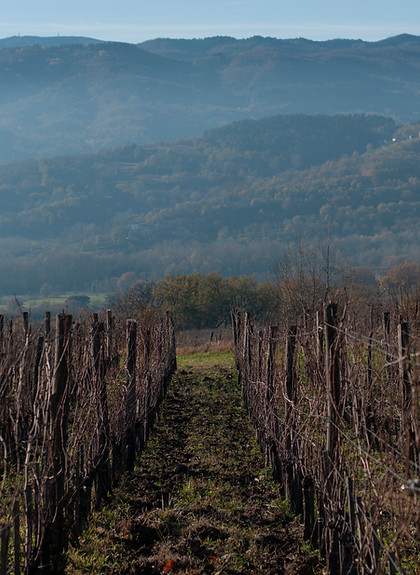
Indeed, at an average planting altitude of around 500 metres above sea level, this mountain curtain experiences a severe thermal inversion phenomenon between daytime and nighttime temperatures, with a gradient difference oscillating between 12 and 15 degrees. This nighttime cooling particularly benefits the grapes during the ripening months.
One can speak of a true ecological niche, surrounded by the 11,000 hectares of the ancient Camaldoli forest (national park), an enormous green lung, with conditions almost alpine, very different from all the other wine regions in Tuscany.


Federico's main objective has been to produce an authoritative wine – through Pinot Noir – and to enhance this very particular environment in a harmonious marriage between Pinot Noir and the territory.

Naturally, the opportunity to work at Ornellaia was at the origin of this wine (from 1985 to 1991) – as the first assignment – and significantly influenced Federico's approach to the vine as a plant and his entire winemaking style. Working hard and closely with André Tchelistcheff, the dean of Californian winemakers and consulting oenologist for Ornellaia, taught Federico that:
Thus, 4.5 hectares of vineyard were planted from 2001 to 2003, then carefully cultivated with deep respect for organic farming and biodynamic inspirations.
The planting density is very high (10,500 vines/Ha), quite similar to the densities in Burgundy, and was planted with a mass selection called “Petit Petit Fin,” chosen to produce about 300 grams of grapes per vine (7-8 vines/bottle).
This small quantity of grapes ensures high expressiveness and concentration in the grapes and therefore in the wine. 44,000 vines produce only 8,000 bottles.
An explicit company vocation towards high craftsmanship and research is distinctly expressed in the choice of Pinot Noir, the Abrostine, and in a myriad of other details and manual skills, in addition to organic certification.

1.
Creating solid foundations in vineyard training always rewards those aiming for excellence.
2.
Time and patience are key elements for those designing long-lived wines in terms of shelf life.

3.
Accuracy in all the small details, without paying too much attention to the cost/benefit ratio, is fundamental for obtaining quality and long-lasting wines.
4.
Focusing on low-yield vineyards is a prerequisite for overcoming difficult vintages each year and always seeking excellence.
With this solid background and a toolkit oriented towards quality, Federico embarked on a path of pure craftsmanship where the vines autonomously produce 300 grams of grapes per vine, where a strict selection in the field of each bunch accompanies only the best berries to the winery, destemming is done manually, and fermentation is allowed only in small open wooden fermenters of 500/700 litres.
Giulio, the second generation of Cuna, who grew up among these rows, began assisting Federico in the spring of 2020 after studying Philosophy in Florence for two years.
After the summer of 2023, feeling the need to lay solid scientific foundations and aiming for an inner understanding of viticulture as a way of life, he departed for Burgundy, where he studied Oenology at the University of Dijon while working day and night at Domaine Confuron - Cotetidot, alongside Monsieur Yves Confuron, a master of whole-bunch fermentation.


The spirit and inspiration that have driven this project through the decades are those of following with the utmost attention and care every single moment of the entire process. Being so close to nature, intimately knowing each individual plant over the years, is a very special blessing that allows us to persevere in this journey of winemaking with great determination and a strong desire for identity. Within this demanding and strict artisanal approach, we truly want to produce not just good wines, but brilliant, vibrant wines capable of courageously challenging the decades to come.
From a technical perspective, the harvest usually takes place over the course of a month, from the second half of September to the second half of October.
Small quantities are harvested weekly to bring different shades and colours (in an organoleptic sense) into the winery, opening up to the complexity of the final palette. Early and young harvests are rich in acidity, important factors that contribute to tension and freshness, with very delicate aromas. Moving into the early autumn weeks of October, youth begins to wane, and once a good phenolic maturity is reached—a key factor in expressing the terroir—the grapes and juice acquire a completely different depth, and the expression becomes even more material and lively.

The grapes are treated with the utmost attention and care; destemming is done by hand rather than by machine to preserve the integrity of the berry as much as possible. We have progressively increased the percentage of whole cluster fermentation, and by the end of the harvest and the final batches, almost 100% of the grapes are poured directly into the fermentation tonneaux and chestnut truncated-conical tanks, without destemming. The ageing lasts 20 months in old 228-litre barriques and a further 24 months in bottle.
Federico and Giulio Staderini
Private Vintners
